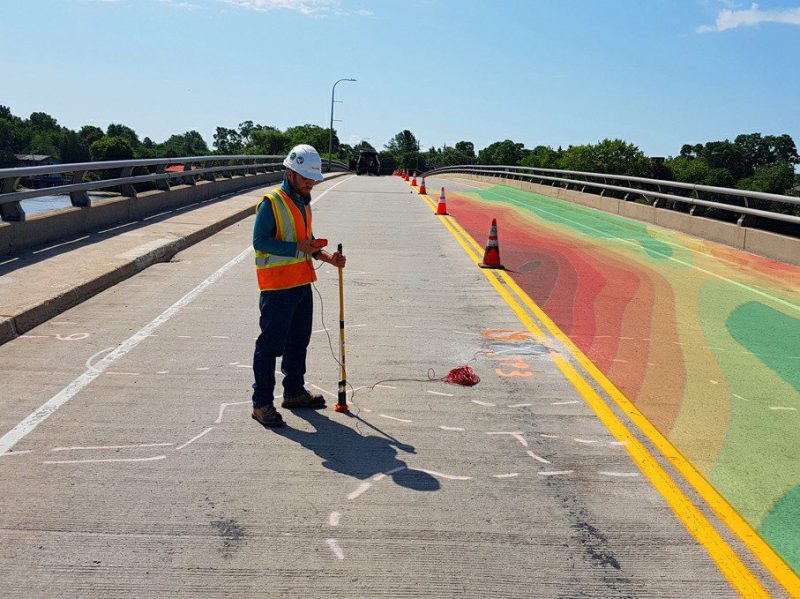
Half-Cell corrosion potential mapping (HCP) is an effective method for assessing the severity of corrosion activity in concrete structures. It is the most well-known procedure to identify the likelihood of active corrosion.
The HCP test consists of measuring the potential difference between a standard reference electrode, normally a copper/ copper sulfate (standard portable half-cell) placed on the surface of the concrete with the steel reinforcement underneath.
Half-Cell corrosion mapping offers a rapid, cost-effective and non-destructive way for corrosion assessment. The test provides valuable information on the likelihood of corrosion, and helps in the quality assurance of concrete repair and rehabilitation. Several standard associations have standardized the test procedure including the ASTM C 876, UNI 10174 and RILEM TC 154. Depending on the measured half cell corrosion potential value, the probability of active corrosion is determined.
When the half-cell corrosion potential measurement is more negative than -350 mV (CSE electrode), then the chance of having active corrosion is more than 90%. When the measured value is more positive than -200 mV, the chance of active corrosion is less than 10%. For potential values between -200 mV and -350 mV, there is uncertainty in interpreting the test results.