Crosshole Sonic Logging – CSL
The Crosshole Sonic Logging (CSL) or Ultrasonic Crosshole Test is a widely used non-destructive test for assessing quality control of concrete piles (deep foundations).
CSL test can be considered a offspring of Ultrasonic Pulse Velocity. In theory, the pulse trasit time is a function of the modulus of elasticity, density, and Poisson’s ratio.
The uniformity and integrity of concrete pile can be assessed by measuring the pulse velocity at different elevations across the pile profile. Crosshole Sonic Logging Test is a great test for identifying Anomalies in concrete shafts such as soil inclusion, poor quality concrete (low density, low modulus), and major voids.
The Concept and Procedure of CSL Test
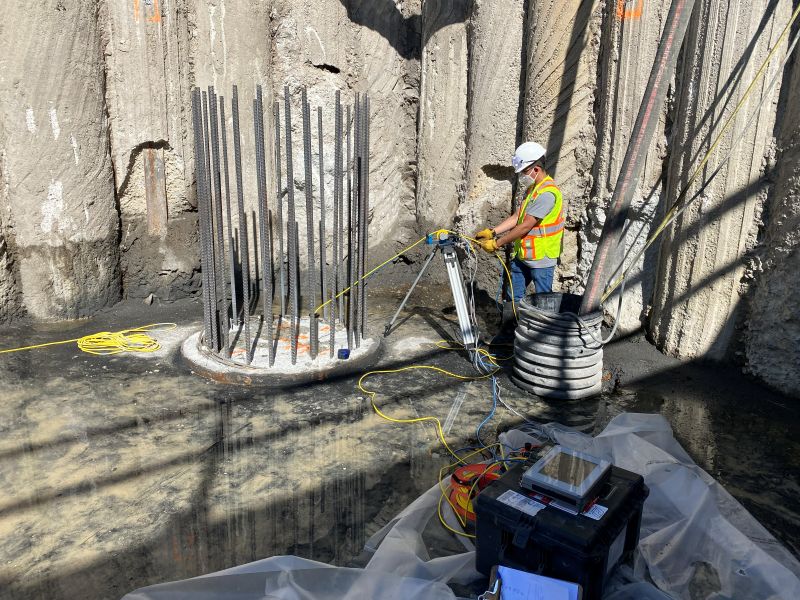
In crosshole sonic logging test, a number of pre-installed access tubes are built inside the reinforcement cage prior to placing concrete. For the purpose of testing, the tubes are filled with water to provide acoustic coupling to the ultrasonic transducers.
The very basic format of the test involves at least two parallel tubes installed. Two transducers (a transmitter and a receiver) are lowered down to the bottom of the shaft, and are pulled up. The transit time of an ultrasonic pulse through the concrete between the tubes is measured by a data logger. As the transducers are pulled up, the ultrasonic pulse signal is collected at certain intervals. This provides engineers with a vertical profile of signal transit time. A modern CSL system uses an automated depth encoder to precisely record the position of the probes inside the access tubes.
In general, the transit time of ultrasonic pulse between every two access tubes is measured using a high precision data acquisition system. The resolution of the scan along elevation can be controlled by the rate of the withdrawal of the transducers in the tube (normally performed form the bottom to top). The resolution of the scan at each elevation depends on a number of parameters, such as the selected frequency (pulse wavelength), the number and horizontal spacing of access tubes. A modern CSL is equipped with transducers that can operate between 25 to 50 kHz, allowing detection of defects as small as 2.5” to 4” (in each horizon). It is recommended to keep the spacing of the probes to about 12’ (3.6 m).
Criteria for Crosshole Sonic Logging
Deep Foundations Institute (DFI) CSL task group has provided a most recent document regarding terminologies and interpretation of CSL test results. According to this document,
- Anomaly: Abnormal data that deviates from expectations, and may indicate a flaw or defect.
- Flaw: Any imperfection in the planned shape or material of the foundation that may not necessarily affect its performance.
- Defect: Any flaw that, because of size, location and inferred concrete properties, will have a significant adverse effect on the performance of the foundation.
Three different categories have been identified for interpretation.
- Class A: Acceptable CSL test results.
Class B: Conditionally acceptable CSL test results.
Class C: Highly abnormal CSL test results.


Relevant Standards and Guidelines
The Pile Integrity Test (PIT) is standardized as:
ASTM D 6760 “Standard Test Method for Integrity Testing of Concrete Deep Foundations by Ultrasonic Crosshole Testing
Please contact us for a free quotation and tell us more about your project