Parallel Seismic
The Parallel Seismic (PS) Test is a non-destructive method used to measure the length (depth) of piles and deep foundations when access to the pile head is inaccessible or blocked by superstructure elements such as slab-on-grade, building foundations, bridge decks, or buried conditions.
The test is often the only viable method for determining embedment depth when traditional surface techniques — like low-strain impact testing — cannot be applied.

Parallel Seismic – The Concept
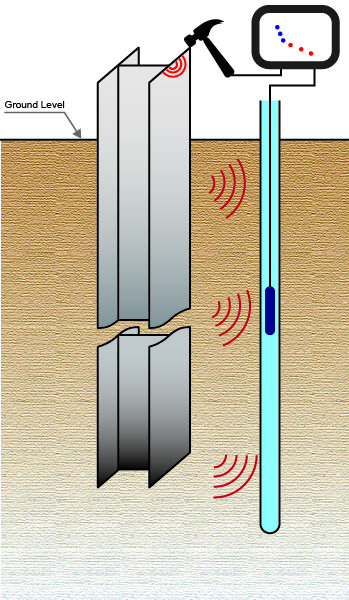
At its core, the Parallel Seismic Test uses stress waves generated by an impact on the structure connected to the pile to measure travel times of compressional and/or shear waves. These waves propagate down the foundation and are picked up by a hydrophone receiver lowered in a borehole drilled parallel to the pile.
Key elements of the method:
A vertical borehole is drilled adjacent to the pile (typically within ~1 m) and extended below the expected pile bottom by several meters.
A plastic access tube is installed in the borehole, filled with water to couple the hydrophone with the surrounding soil and facilitate wave transmission.
A controlled impact (usually a hammer blow) is delivered to the structure, cap, or accessible part of the foundation to generate stress waves.
As the receiver is moved up the borehole, the arrival times of the first compressional wave at each depth are recorded.
By plotting first-arrival travel time vs depth, characteristic changes in the slope of this curve indicate the transition at the pile toe (pile bottom), since wave speed changes when the wave exits the pile and enters surrounding soil.
Applications of Parallel Seismic Test
The PS Test is especially useful in the following situations:
Existing buildings or bridges where the pile head cannot be accessed.
Long or slender piles (e.g., H-piles, sheet piles, drilled shafts) where conventional low-strain methods are ineffective.
Projects requiring confirmation of pile embedment depth for retrofit, reuse, or geotechnical assessment.
Conditions where other NDT methods, such as low-strain impact or crosshole sonic logging, are not feasible.
PS testing can also provide useful information about the subpile soil or strata below the foundation toe when interpreted properly.
Advantages
- Non-destructive and minimally invasive; no need to disturb the structure or pile itself.
- One of the most accurate NDT methods for depth estimation, often within ±5 % or better under good site conditions.
- Applicable for a wide range of pile types and materials.
Limitations and Challenges
Despite being powerful, the PS Test has limitations that practitioners should be aware of:
Borehole installation adds cost and requires space and logistical access to drill near the pile.
The borehole must be filled with water and properly coupled with soil to ensure good signal transmission.
If the borehole is too far from the pile (> ~1 m), interpretation becomes more complex and less reliable due to noise and signal dispersion.
The method is not primarily a pile integrity test; it focuses on length/depth rather than internal defects.
Soil conditions can influence wave propagation, affecting signal clarity and interpretation.
These factors reinforce the need for experienced technicians and engineers to plan, acquire, and interpret PS test data correctly.
Applicable Standards
Parallel Seismic testing has been formalized in industry standards, providing minimum requirements and guidance for field practice:
ASTM D8381/D8381M – Standard Test Methods for Measuring the Depth of Deep Foundations by Parallel Seismic Logging: Defines procedures using access tubes or seismic cones to measure vertical deep foundation depth when other surface methods are not practical.
ACI 228.2R (Concrete Durability and NDT guide) discusses PS testing concepts and its use for foundation length and condition assessment, though not as a primary prescriptive standard.
Please contact us for a free quotation and tell us more about your project