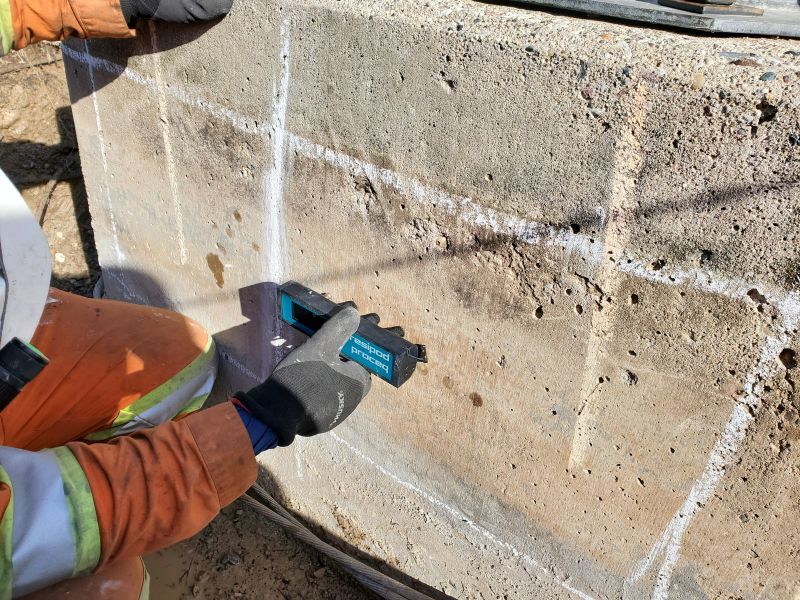
Surface Electrical Resistivity of Concrete testing is a non-destructive method used to evaluate the ability of concrete to resist the movement of electrical current and ions.
Because ionic transport governs moisture movement and chloride ingress, surface resistivity is widely used as an indicator of concrete durability and corrosion risk in reinforced concrete structures.
The test is commonly applied to bridges, parking structures, marine and industrial facilities, foundations, and slabs, both in new construction and existing structures.
The Concept
Electrical resistivity is defined as the opposition of a material to the flow of electrical current. In concrete, current is primarily conducted through the pore solution, making resistivity strongly influenced by:
Moisture content
Pore structure and connectivity
Chloride concentration
Cementitious materials and mix design
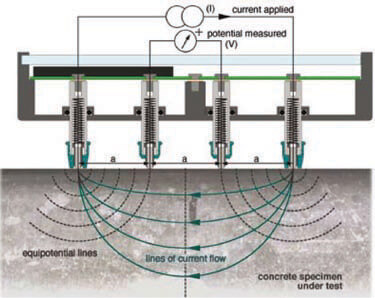
Surface resistivity is typically measured using a four-point Wenner probe, which applies an alternating current through the outer probes and measures the resulting voltage between the inner probes.
ρ=2πa V/I
Where:
ρ = surface resistivity (kΩ·cm)
a = probe spacing
V= measured voltage
I= applied current
Applications
Surface electrical resistivity testing is commonly applied to:
Assess durability performance of concrete (materials and structures)
New construction quality control
Condition assessment and durability studies
Applicable Standards and Guidance
Surface electrical resistivity testing is governed by well-established standards:
AASHTO T 358 – Standard Method of Test for Surface Resistivity Indication of Concrete’s Ability to Resist Chloride Ion Penetration
ASTM C1876 – Standard Test Method for Bulk Electrical Resistivity or Bulk Conductivity of Concrete
Integration with Corrosion and Durability Assessment
Surface resistivity is most powerful when combined with: