
Scope
FPrimeC was hired by an asset management company to perform non-destructive testing for structural Condition Assessment of Underground Building in Yorkton, Saskatchewan. The underground building under investigation was primarily used as fitness centre. The roof was a One-Way reinforced Concrete Slab supported over concrete beams. Concrete slab showed sign of moderate corrosion and leakage at several locations.
Condition Assessment of Underground Building
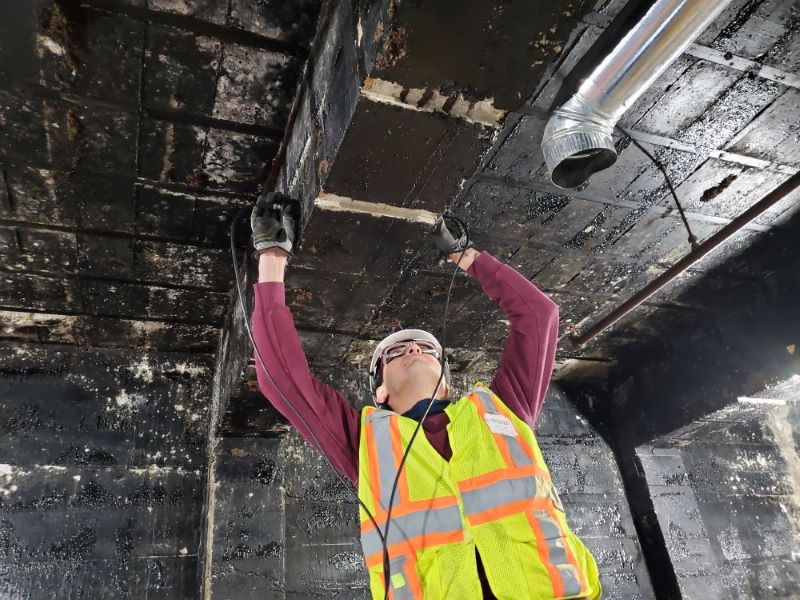
A multi-modal non-destructive evaluation program was designed and implemented for condition assessment of underground Building, and to assess key geometry and structural parameters.
- Half-Cell Corrosion Potential Mapping (HCP) was used to study the likelihood of active corrosion in concrete beams. The test allowed for accurate assessment of the current condition of the beams.
- Ultrasonic Pulse Velocity (UPV) was used to evaluate the quality and uniformity of concrete at the stem of beams. The direct UPV was performed to assess concrete on a comparative basis.
- Rebound Hammer test was used to estimate the in-place concrete strength.
- Ground Penetrating Radar (GPR) was used to identify the structural details, such as rebar spacing, and rebar distribution in the concrete slab.
- Ultrasonic Pulse Echo (UPE) was used to verify and estimate the thickness of foundation walls.
Advantages
The use of Non-Destructive Evaluation methods in the condition assessment of underground building had several key advantages:
- It eliminated the need for intrusive assessment. In a regular assessment, verifying the thickness would have required drilling exploratory concrete cores. The NDE program was able to address the questions on larger areas, and with great accuracy.
- NDE program allowed for a larger number of elements being tested and evaluated. Conventional coring program is often limited to certain number of elements, whereas NDE program can be expanded without further damage to structure.
- The information helped identify key structural details, such as element thickness, rebar quantity and configuration, and help engineers in evaluating the load bearing capacity of existing structure.