
Introduction
Heavy industrial machinery operates under extreme conditions that place immense stress on the foundation system. Over time, the combination of intense thermal cycles and heavy dynamic loading can degrade the integrity of reinforced concrete supports, leading to potential stability issues such as sliding, overturning, or settlement.
FPrimeC Solutions was engaged to perform a targeted Structural Health Monitoring (SHM) program for a series of massive concrete piers supporting critical industrial infrastructure. Following a preliminary inspection that raised concerns regarding potential reinforcement continuity at the base of the structures (due to potential fatigue), the facility owners sought a precise, data-driven assessment to verify the stability of the foundation under live operational loads.
The Challenge
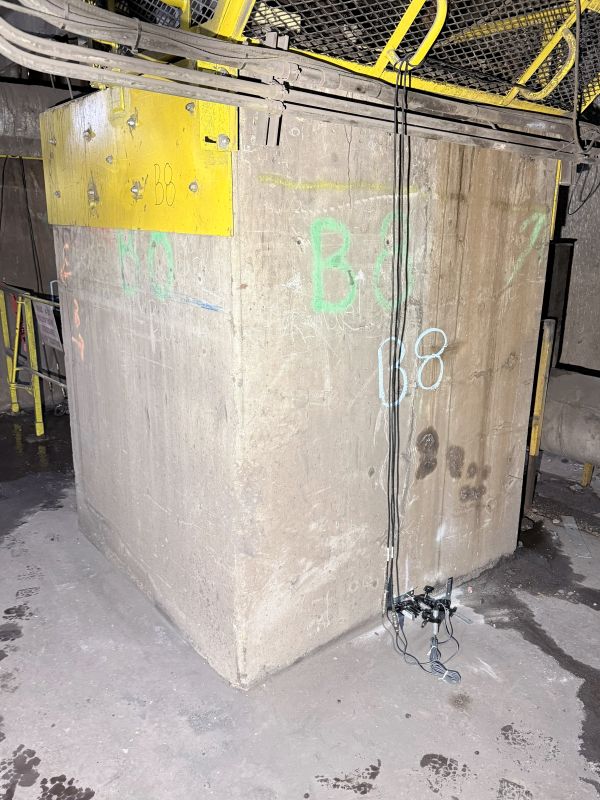
The project site involved a series of large concrete piers, each measuring approximately 6 ft x 6ft. These piers serve as the foundational support for heavy moving equipment.
The primary engineering concern stemmed from a preliminary investigation suggesting potential structural deficiencies at the base of specific supports. This raised a critical question: were the adjacent piers also compromised, or were they exhibiting signs of distress?
- The piers are subjected to transient loads every time heavy product passes over them. The monitoring system needed to be sensitive enough to capture these millisecond-scale “heartbeats” of the structure.
- Beyond instantaneous loads, the structures are subject to thermal expansion and potential creep. The solution required distinguishing between reversible elastic deformation and permanent, progressive failure.
The Solution: Precision Instrumentation and Monitoring
To address these challenges, FPrimeC Solutions designed and deployed a customized instrumentation plan using Linear Variable Differential Transformers (LVDTs). LVDTs are electromechanical transducers that provide highly accurate, frictionless measurement of linear displacement. Read More About Sensors in SHM
To capture the full kinematic behavior of the piers, a bi-directional sensor array was installed at the base of each monitored pier:
- Vertical Displacement: One LVDT was mounted in a vertical configuration to detect potential uplift or overturning moments. This sensor was crucial for identifying if the piers were “rocking” under load due to insufficient anchorage.
- Horizontal Displacement: A second LVDT was mounted horizontally to measure shear slip or lateral translation relative to the floor. This aimed to detect if lateral forces were causing the structures to slide.
Data Acquisition Strategy
The monitoring window spanned approximately 240 hours (10 days), capturing a complete operational cycle. This duration was strategically chosen to include:
-
Baseline: A period of inactivity to establish zero-readings.
-
Operational Start-up: To capture the initial thermal expansion and load uptake.
-
Continuous Operation: To record thousands of cyclic loading events.
-
Operational Pause: A pause in operations allowed the team to observe the structure’s relaxation behavior.
Methodology: Short-Term vs. Long-Term Analysis
A key differentiator in FPrimeC’s approach was the dual-analysis framework. Raw data is simply noise without context; therefore, the analysis was split into Short Duration and Long Duration studies to isolate different failure mechanisms.
1. Short Duration (Transient Dynamic Response)
This analysis focused on high-frequency windows to demonstrate instantaneous relative displacements. As heavy loads transited the system, they induced transient forces on the piers.
-
The “Heartbeat” of the Structure: The data revealed distinct, rhythmic peaks in displacement corresponding to individual loading events.
- Elasticity Check: By analyzing the shape of these peaks, FPrimeC engineers could determine if the deformation was elastic (returning to zero) or plastic (permanent shift).
- Abnormality Detection: The amplitude of these peaks served as a proxy for stiffness. A structure showing significantly higher peaks than its neighbors could indicate compromised internal reinforcement or a “soft” boundary condition.
2. Long Duration (Cumulative Trends)
The full time-history was analyzed to track slow-moving phenomena.
- Drift and Creep: The primary goal was to identify “drift”—a gradual, non-recoverable shift in the baseline position. If a pier moves incrementally and never returns, it indicates a progressive failure mechanism such as sliding or foundation settlement.
Conclusion
This project exemplifies the value of non-destructive Structural Health Monitoring in heavy industrial environments. By deploying high-precision sensors and applying rigorous data analysis techniques, FPrimeC Solutions was able to provide the client with a clear “health check” of their critical assets.
Instead of relying on guesswork or expensive, disruptive destructive testing, the facility managers now possess a detailed map of their foundation’s performance, allowing for optimized maintenance budgets and enhanced operational safety.