
NDT-Based Condition Assessment of Bridge
Maintaining the structural integrity of iconic transportation infrastructure is vital for public safety and the efficient movement of people and goods. Over time, bridge decks and associated components face significant wear from heavy traffic loads, freeze-thaw cycles, and the aggressive use of de-icing salts. Regular, in-depth condition surveys are essential to detect early signs of deterioration, such as rebar corrosion and concrete delamination, before they evolve into critical failures.
FPrimeC Solutions was commissioned to perform a NDT-Based condition assessment of the iconic Jacques-Cartier Bridge in Montreal, Quebec. The project focused on assessing the current state of specific structural elements of the deck to inform future maintenance and rehabilitation strategies.
The Challenge
The project scope encompassed a diverse range of structural components, each with unique access and assessment challenges:
-
Downstream Ramp: This curved section required evaluation of both the top driving surface and the soffit (underside). Challenges included managing traffic control for night work and accessing the soffit for close-up visual inspection.
-
Bridge Deck Spans: Specific high-traffic spans needed non-destructive evaluation to determine the condition of the concrete deck beneath the asphalt overlay without causing significant traffic disruption.
The primary engineering objective was to move beyond simple visual observation and quantitatively assess the condition of the reinforced concrete, specifically looking for:
-
Subsurface delamination not visible to the naked eye.
-
The extent of potential corrosion in the reinforcement.
-
Determine certain mechanical and durability characteristics of concrete core samples
The Solution: Integrated NDT and Intrusive Testing
To deliver a robust assessment, FPrimeC Solutions implemented a multi-tiered testing program that integrated advanced Non-Destructive Testing (NDT) with targeted intrusive sampling.
1. Ground Penetrating Radar (GPR) Scanning
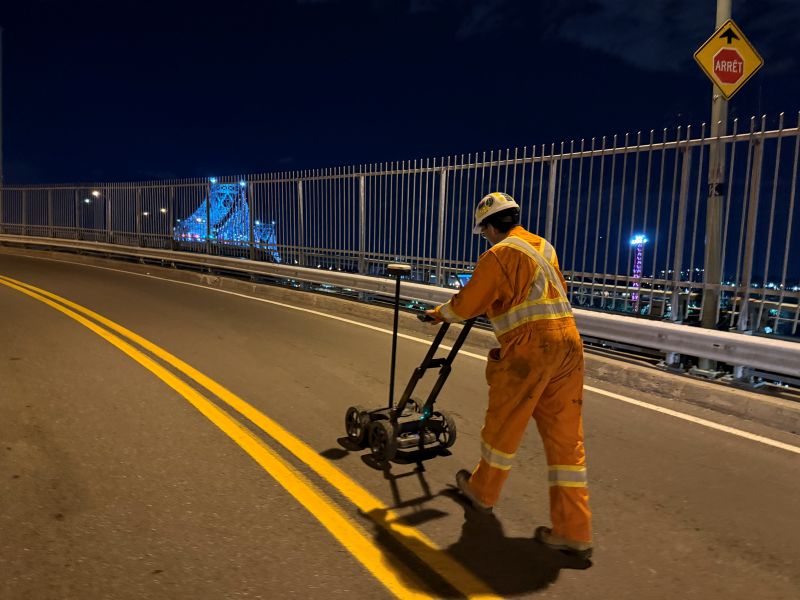
Advanced stepped frequency GPR systems were deployed to scan the bridge deck and ramp surfaces.
-
Purpose: To map rebar configuration (spacing and cover), identify potential delamination, and detect areas of likely corrosion.
-
Methodology: A combination of different GPR units was used to optimize data collection. The data analysis involved generating “amplitude heat maps.” Weak reflection amplitudes in these maps typically indicate signal attenuation caused by conductive environments—often a strong proxy for active corrosion, high moisture, or chloride contamination.
2. Visual Inspection and Sounding
A detailed visual survey was conducted to document surface defects such as cracking, spalling, and exposed reinforcement.
- Tech-Enabled Inspection: FPrimeC utilized LiDAR-enabled digital inspection tools to accurately map defects in 3D space, ensuring precise location tracking for future repairs.
- Hammer Sounding: Traditional sounding was performed on accessible top surfaces to audibly detect hollow areas indicative of delamination.
3. Intrusive Coring and Laboratory Testing
To validate the NDT findings, concrete core samples were extracted from strategic locations.
-
Compressive Strength: Cores were crushed to determine the strength of the concrete.
-
Chloride Ion Content: Samples were sliced at various depths (horizons) to measure chloride profiles. This is critical for estimating how deep salt has penetrated and if it has reached the steel reinforcement threshold to initiate corrosion. This information was later used for evaluating the service life of the bridge structure.
-
Air Void Analysis: Select cores underwent microscopic analysis to evaluate the freeze-thaw durability of the concrete paste.
Conclusion
The comprehensive survey of the Jacques-Cartier Bridge components successfully established a detailed baseline of the structure’s current condition. The integration of GPR mapping with physical core testing confirmed that while the overall concrete quality and reinforcement condition are generally acceptable, specific zones—particularly near curbs and joints—require targeted maintenance.
By quantifying the extent of “invisible” deterioration, FPrimeC Solutions provided the client with the data needed to prioritize repairs, specifically addressing the localized corrosion risks identified by the GPR amplitude maps, ensuring the continued longevity of this vital transportation link.