
Durability Assessment of Sulphur Pit
How Non-Destructive Evaluation Help
Project Overview
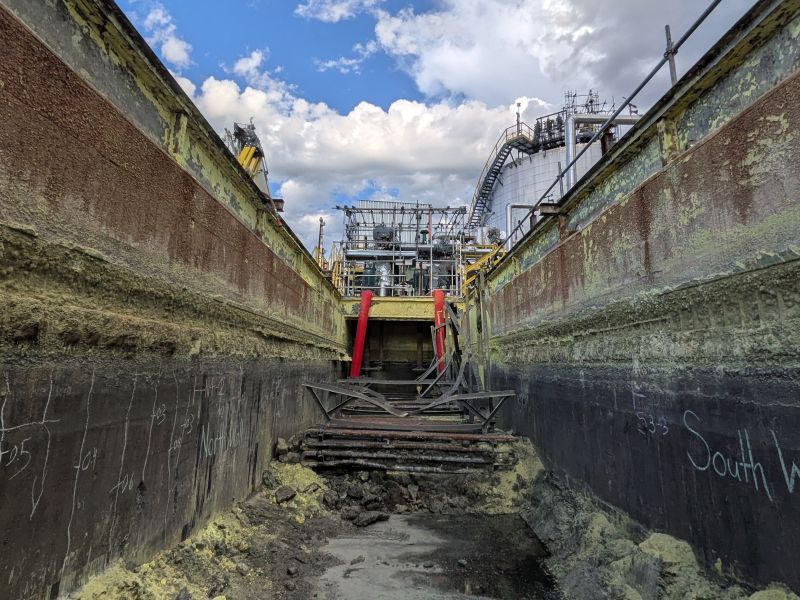
FPrimeC Solutions was engaged to support the Condition Assessment of Sulphur Pit at an industrial facility in Alberta. Sulphur pits operate in a particularly challenging environment, where concrete and reinforcing steel may be exposed to molten sulphur and evaporations, resulting in premature deterioration of the tanks structure, resulting in concrete cracking, reinforcement corrosion, and loss of protective concrete cover is common (Read More).
The objective of the investigation was to develop a clear understanding of the condition of the accessible concrete surfaces and establish a technical basis for maintenance and repair planning. The assessment combined detailed visual inspection with multiple non-destructive testing (NDT) techniques to evaluate both visible deterioration and potential subsurface conditions.
Assessment of Sulphur Pit – Step by Step Methodology
FPrimeC developed a systematic inspection and NDT program combining several complementary techniques. This multidisciplinary approach provided valuable information about the overall condition of the sulphur pit. Visual inspection establishes the nature and distribution of surface deterioration, while NDT provides additional information about the condition of the concrete and internal structural features.
1. Visual Condition Survey and Hammer Sounding
Visual condition survey of sulphur tanks is generally a complex task. Since these tanks are usually in operation, access to the inside of the tank is only limited to short shut-down windows. Digital inspection using LiDAR and Photos helped assess this relatively large pit in a very short period.
- The investigation began with a detailed visual condition survey of the accessible concrete surfaces. Visible defects and deterioration mechanisms were documented and mapped, including cracking, surface deterioration, deposits, exposed reinforcement, and areas of concrete loss.
- Crack widths were measured using a calibrated crack-width gauge, while hammer sounding was used to identify areas potentially associated with near-surface delamination or other anomalies.
- Digital documentation and LiDAR-based reality capture were also incorporated into the inspection process to support systematic recording and mapping of surface defects.
2. Non-Destructive Evaluation and Assessment of Sulphur Pit
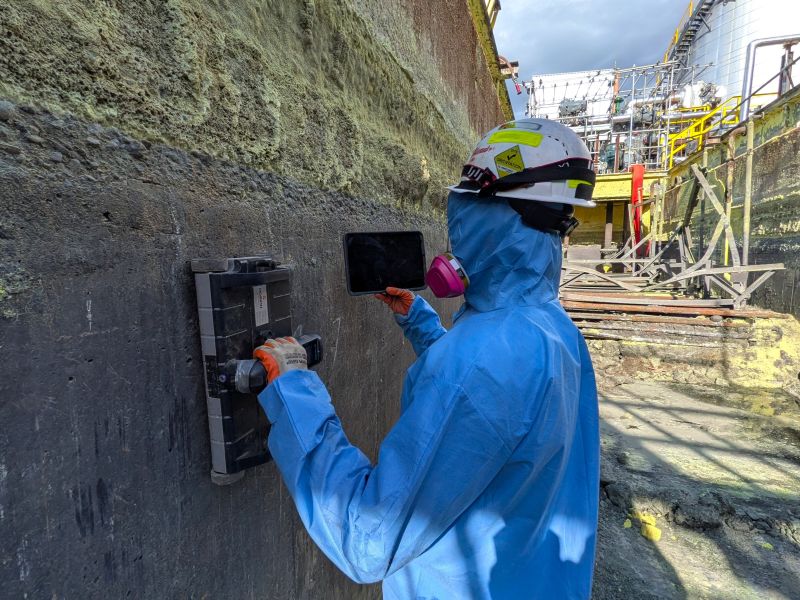
A multi-modal NDT program was designed and implemented to assess the location and extent of anomalies in concrete walls.
- Ultrasonic Pulse Velocity (UPV): Ultrasonic Pulse Velocity testing was used to assess the quality, homogeneity, and integrity of the concrete. The investigation used an indirect UPV configuration to accommodate the available access conditions. Variations in ultrasonic pulse velocity can help identify areas requiring further investigation and can provide insight into potential cracking or subsurface anomalies.
- Crack Depth Assessment: For selected cracks, a specialized UPV configuration was used to estimate the depth of crack propagation. This approach provides additional information beyond crack width measurements by helping determine whether visible surface cracking is relatively shallow or extends significantly into the concrete section.
- Ground Penetrating Radar (GPR): GPR scanning in horizontal and vertical directions provided information on reinforcement location, distribution, and depth while also supporting the identification of areas that may warrant additional investigation for conditions such as voids or delamination. Learn more
The combination of these techniques allows engineers to distinguish between visible surface deterioration and conditions that may extend into the concrete section, helping prioritize areas for further investigation, maintenance, and repair.
FPrimeC’s Approach
This project demonstrates FPrimeC’s integrated approach to concrete durability assessment and non-destructive evaluation of industrial infrastructure.
By combining advanced NDT methods with detailed visual condition mapping and digital reality capture, FPrimeC can help asset owners better understand the condition of aging concrete structures while minimizing unnecessary destructive investigation.
For structures exposed to aggressive industrial environments, a properly designed condition assessment can provide the information required to develop targeted repair strategies, prioritize maintenance activities, and support long-term asset integrity management.
FPrimeC Solutions provides advanced non-destructive testing, concrete condition assessment, durability evaluation, and repair-support services for industrial and infrastructure assets across Canada.