Low Strain Pile Integrity Test – PIT
Concept Behind Pile Integrity Testing
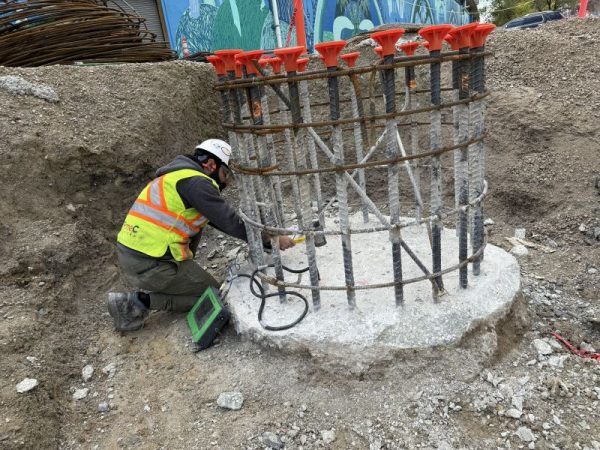
Low-strain testing is based on stress wave propagation and reflection:
A light impact is applied to the top (head) of a pile using a hand-held hammer.
This impact generates a compressive stress wave that travels down the pile shaft.
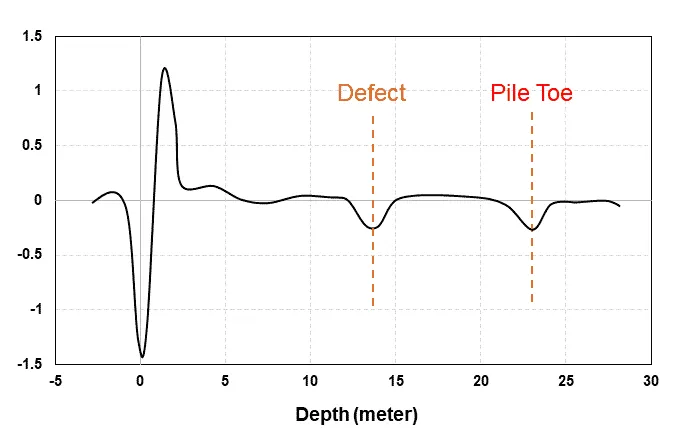
When the wave encounters a change in impedance—caused by the pile toe, a cross-section change, voids, cracks, or inclusions—it reflects back toward the pile head.
A motion transducer (typically an accelerometer or velocity sensor) mounted at the pile head records the reflected signals.
By analyzing the arrival times and amplitude changes, engineers infer structural features and anomalies
Applications of Low Strain Pile Integrity Test
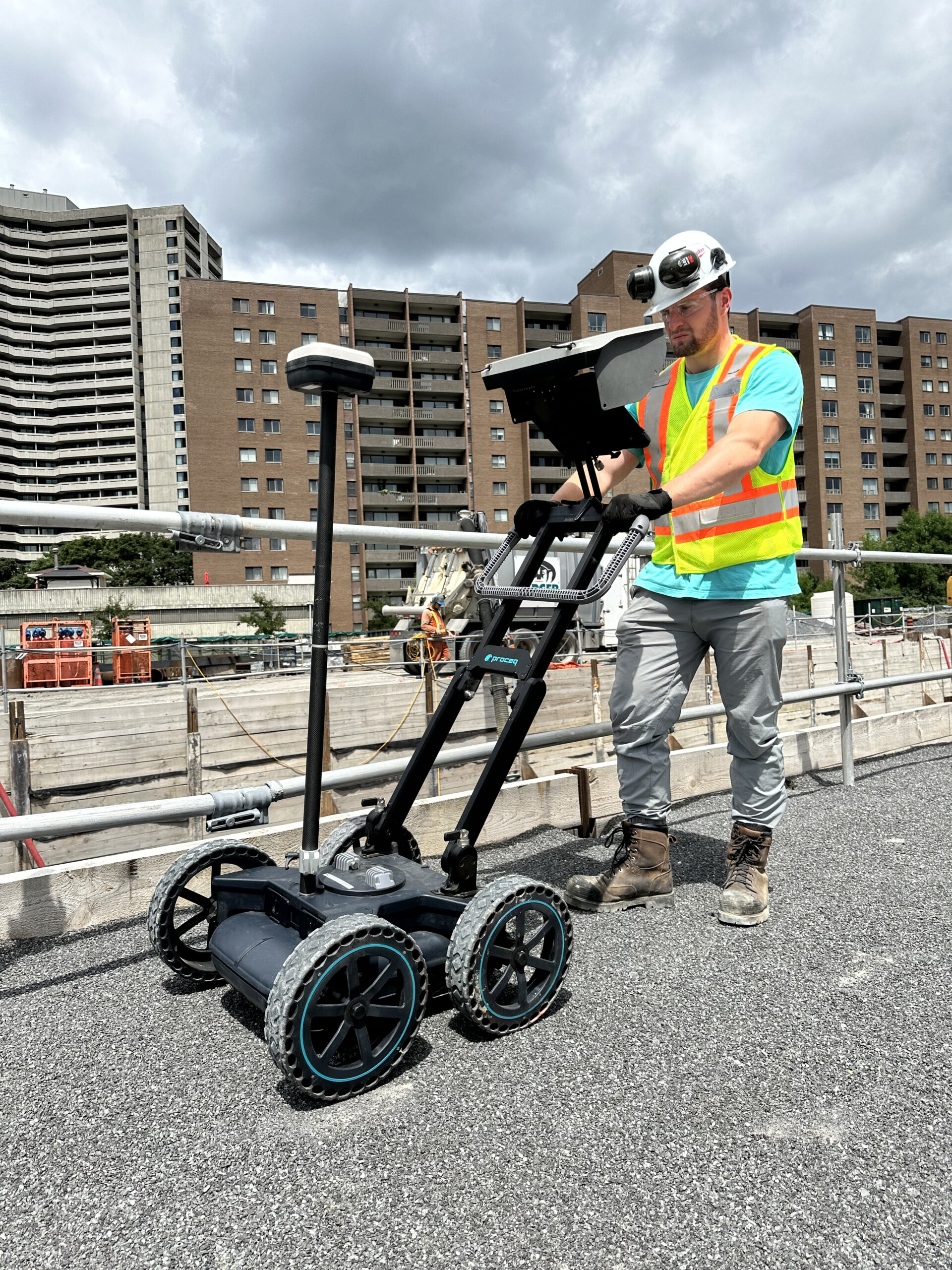
In soils and geophysics studies, GPR is used for:
Utility detection and mapping
Identifying buried foundations and structures
Estimating pavement and soil layer thickness
Detecting voids, sinkholes, and anomalous zones
Supporting environmental and infrastructure investigations
What Information Does the Test Provide?
Low-strain pile testing can help evaluate:
- Pile continuity and integrity: Identifying necking, bulging, voids, cracks, or major cross-section changes.
- Consistency of concrete quality: Indications of segregation, honeycombing, or soil inclusion zones.
- Estimated pile length: When the toe reflection is clear, depth estimation is possible.
- General structural condition: Broad assessment of the pile at minimal cost and time.
Limitations and Considerations
While valuable, low-strain pile integrity testing has some limitations:
It does not measure bearing capacity or load-bearing performance.
Testing may be challenging in piles with highly variable cross sections, very long lengths, or complex reinforcement.
Pile caps and structural elements above the pile head can obscure wave propagation and complicate interpretation.
Interpretation requires experience and engineering judgment to distinguish reflections from noise.
Relevant Standards and Guidelines
The Pile Integrity Test (PIT) is standardized as:
ASTM D5882 – Low Strain Impact Integrity Testing of Deep Foundations.
Please contact us for a free quotation and tell us more about your project