
The Ultimate Guide to Foundation Decarbonization: Applications of Non-Destructive Testing in Foundation Re-use
The global construction industry is undergoing a seismic shift. As the realities of climate change become impossible to ignore, civil engineers, asset owners, and urban planners are heavily scrutinizing the environmental footprint of our built environment. Historically, the focus of sustainable construction has been on operational carbon—the emissions generated by heating, cooling, and powering a building. However, a massive portion of a structure’s environmental impact lies in its embodied carbon, with deep foundations and substructures often accounting for up to 30% to 40% of a project’s total carbon footprint. In Canada, asset owners such as Ministry of Transportation in Ontario have been considering foundatio re-use in the recent years (see Tony Sangiuliano et al., Foundation Re-use Conference 2024)
To combat this, the concept of “foundation decarbonization” has emerged as a leading strategy. The most effective way to decarbonize a foundation is simple in theory but complex in execution: re-use it. By leaving existing piles, caissons, and footings in the ground and retrofitting them to support new superstructures, we can eliminate the massive emissions associated with extracting, manufacturing, and pouring new concrete and steel.
However, re-using a foundation introduces profound engineering challenges.
- How do we know how deep the existing piles go?
- What is their current structural integrity after decades in the ground?
To answer these questions without destroying the very assets we are trying to save, the industry is turning to advanced Non-Destructive Testing and Evaluation (NDT-E).
In this comprehensive article, we will explore the applications of NDT-E in foundation decarbonization and re-use. We will categorize the most pressing challenges associated with re-purposing old foundations, delve into the cutting-edge NDT methods available today.
The Imperative of Foundation Re-use and Decarbonization
Decarbonization in civil engineering requires us to move away from the traditional “demolish and replace” mindset. Extracting old foundations is not only incredibly expensive and disruptive to dense urban corridors, but it also releases trapped carbon and disturbs the soil matrix. Pouring new concrete piles requires energy-intensive cement production, which is responsible for roughly 8% of global CO2 emissions.
Re-using existing foundations effectively bridges the gap between infrastructure modernization and environmental stewardship. Recent research shows that integrating rigorous non-destructive evaluation frameworks into the early stages of project planning can significantly derisk foundation re-use, maximizing carbon savings while strictly adhering to safety codes. NDT-E provides the vital data needed to justify the retention of existing substructures to regulatory bodies, making foundation decarbonization a viable, data-driven reality rather than an abstract environmental goal.
Challenges with Foundation Re-use
Re-using an existing foundation is not as simple as building on top of old concrete. The substructure must be thoroughly vetted to ensure it can perform safely for another lifecycle. We can categorize the most common challenges of foundation re-use into five distinct areas:
1. Sustainability Challenges
While the end goal of foundation re-use is sustainability, the verification process itself poses challenges. The project team must weigh the environmental and financial costs of conducting extensive intrusive testing (like massive excavation or daylighting) against the carbon savings of reusing the pile. If verification requires heavy machinery, extensive soil removal, and site disruption, the carbon footprint of the testing phase begins to eat into the decarbonization benefits. This is why non-intrusive NDT-E methods are essential—they provide the necessary structural data with a near-zero carbon footprint.
2. Bearing Capacity
One of the most critical questions engineers face is: Can this foundation support the new load? Often, modern superstructures are taller, heavier, or have different load distributions than the buildings they replace. Furthermore, as-built records for older foundations are frequently lost, inaccurate, or non-existent. Without knowing the exact length, diameter, and embedment depth of the existing piles, calculating their ultimate bearing capacity is impossible. Engineers must rely on NDT-E to retroactively determine pile geometry so that accurate geotechnical and structural capacities can be established.
3. Durability
Foundations exist in harsh, unforgiving environments. They are subjected to fluctuating water tables, aggressive soil chemicals (like sulfates and chlorides), and stray electrical currents. Over decades, these factors degrade the materials. Evaluating the durability of an existing foundation means assessing the current state of concrete degradation and steel corrosion. The challenge lies in quantifying this deterioration when the asset is buried deep underground. If a pile has suffered severe loss of cross-sectional area due to corrosion, its remaining durability may not be sufficient for a second life.
4. Structural Integrity
Beyond slow-acting durability issues, engineers must verify the immediate structural integrity of the foundation. During its first service life, the foundation may have sustained hidden mechanical damages. This includes cracking from past seismic events, overloading, uneven settlement, or even defects that occurred during the original construction phase (such as soil inclusions, necking, or honeycombing in cast-in-place concrete). Water flow can also cause scour, eroding the soil support around the pile and compromising its stability. Detecting these structural anomalies without excavating the entire pile is a monumental challenge that only specialized NDT-E can solve.
5. Longer Service Life for Critical Structures (e.g., Bridges)
When re-using foundations for critical infrastructure like highway bridges, the stakes are exponentially higher. A standard commercial building might be designed for a 50-year lifespan, but modern critical bridges are often engineered for a 75- to 100-year service life. If a bridge foundation that is already 40 years old is to be re-used for a new 100-year superstructure, it must be proven capable of surviving 140+ years in total. This requires hyper-accurate predictive modeling based on current NDT-E data. The margin for error is virtually zero, demanding the highest tier of diagnostic accuracy to guarantee long-term public safety.
NDT-E Methods Available for Foundation Assessment
To overcome these challenges, engineers utilize an array of sophisticated Non-Destructive Testing and Evaluation methods. These techniques allow us to “see” underground and assess both the geometry and the health of existing deep foundations.
Methods for Evaluating Pile Length
When as-built records are missing, determining the depth of the foundation is the first step in calculating bearing capacity. As detailed in our guide on 3 Methods for Evaluating Pile Length, several technologies excel in this area:
-
Parallel Seismic (PS) Method: This is one of the most dependable NDT tools for length estimation. A borehole is drilled adjacent to the existing pile, and a hydrophone is lowered into it. A controlled impact is delivered to the top or side of the pile, generating mechanical stress waves. By measuring the wave arrival times at various depths in the borehole, engineers can accurately pinpoint the pile toe (bottom). Read More on Parallel Seismic
-
Length Induction Test (LIT): Ideal for metallic foundations (like H-piles and steel sheet piles), LIT works similarly to a highly sensitive metal detector. A probe is lowered into a parallel borehole, and changes in the induced electromagnetic voltage are recorded. A sharp voltage drop indicates the termination point of the steel pile. Read More on Length Inductive Testing
-
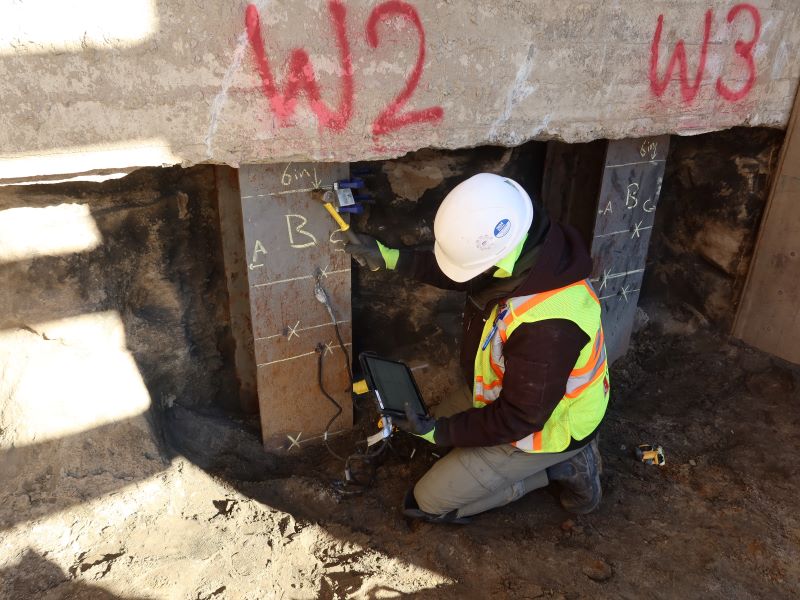
Guided Waves Method: A highly innovative approach ideal for complex urban environments where drilling a borehole isn’t feasible. Small accelerometers are attached to the exposed portion of the pile. Stress waves are introduced, and sophisticated algorithms (like the Spectral Element Method) analyze the phase shift and dispersion of the waves to estimate the pile’s total length.
Methods for Evaluating Structural Integrity and Condition
Once the length is determined, the foundation’s health must be verified. Our comprehensive overview on How to Evaluate Existing Piles and Foundations highlights several key methods:
-
Low-Strain Pile Integrity Test (PIT): A rapid, non-intrusive dynamic test. A handheld hammer strikes the pile head, sending a stress wave down the shaft. Reflections of this wave bounce back from the pile toe or from any significant internal defects (like severe cracking or necking). The signal is analyzed to assess overall continuity.
-
Ground Penetrating Radar (GPR): Utilizing electromagnetic waves, GPR can be used on exposed foundation elements (like pile caps or shallow footings) to map internal reinforcement, verify concrete cover, and detect subsurface voids or moisture ingress.
-
Ultrasonic Testing & Acoustic Emission: Ultrasonic pulse-echo techniques are incredibly useful for assessing the integrity of embedded elements like anchor bolts, detecting corrosion and cracking long before they become visible. Acoustic Emission monitoring can also be deployed to listen for active micro-cracking under load.
-
Electrochemical Methods (HCP): Half-Cell Corrosion Potential can be used on exposed concrete foundation sections to assess the probability of active steel reinforcement corrosion, providing vital data for durability forecasting.

Conclusion
The push for foundation decarbonization represents a pivotal evolution in civil engineering. By prioritizing the re-use of existing piles and substructures, the construction industry can drastically slash its embodied carbon footprint and move closer to global sustainability targets. However, foundation re-use is only safe and viable when underwritten by accurate data.
Advanced Non-Destructive Testing and Evaluation (NDT-E) provides the essential bridge between environmental ambition and structural reality. By addressing the challenges of bearing capacity, durability, and structural integrity through methods like Parallel Seismic, Guided Waves, and Pile Integrity Testing, engineers can confidently grant existing foundations a safe, reliable, and sustainable second life.