
Condition Assessment of Tunnel in GTA
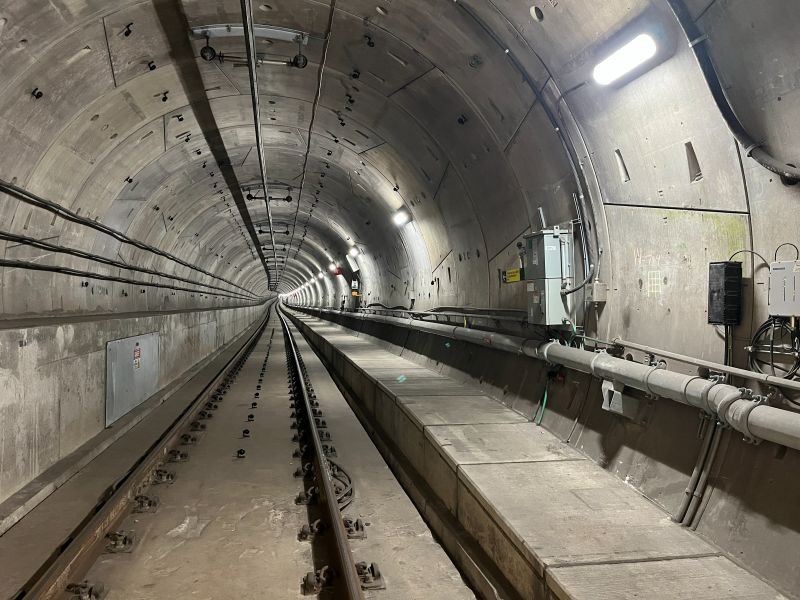
FPrimeC Solutions was engaged to perform condition assessment of tunnel in GTA. The primary objective was to establish a rigorous, accurate baseline record of a transit station’s platform-level elements, encompassing precast concrete tunnel linings, cast-in-place headwalls, station walls, and track slabs. A strategic, three-tiered investigative framework was designed and deployed, combining advanced non-destructive testing, high-resolution geometric scanning using LiDAR, and meticulous physical inspections to create a complete diagnostic profile.
The Foundation of Visual and Physical Inspection
A comprehensive visual condition survey was performed by engineering teams to identify the location and extent of potential concrete deficiencies. Water leaks through joints, joint gaps, and inward movements, and cracks were carefully studied. Advanced digital inspection solutions including LiDAR was deployed.
LiDAR for Assessment of Ovality
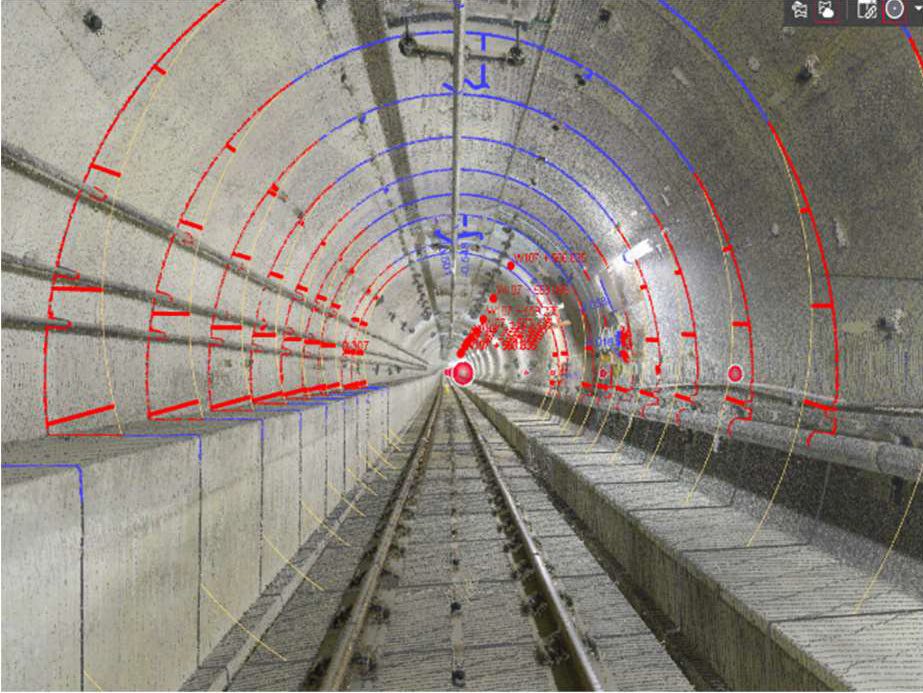
As part of the condition assessment, the ovality of the tunnel cross-section was studied. The LiDAR survey was deployed to establish an exacting baseline record of the existing tunnel geometry, specifically focusing on the tunnel’s shape, overall alignment, and radial ovality.
This digital twin allowed analysts to measure the precise degree of radial ovality—tracking both inward and outward deviations from the intended perfect circle. Integrating this high-tech spatial data with the visual survey allowed the assessment team to correlate physical distress signals, like the stepping of concrete segments or specific water ingress points, with areas experiencing the highest degrees of geometric deformation. Learn more about LiDAR here
Non-Destructive Evaluation of Tunnel Lining
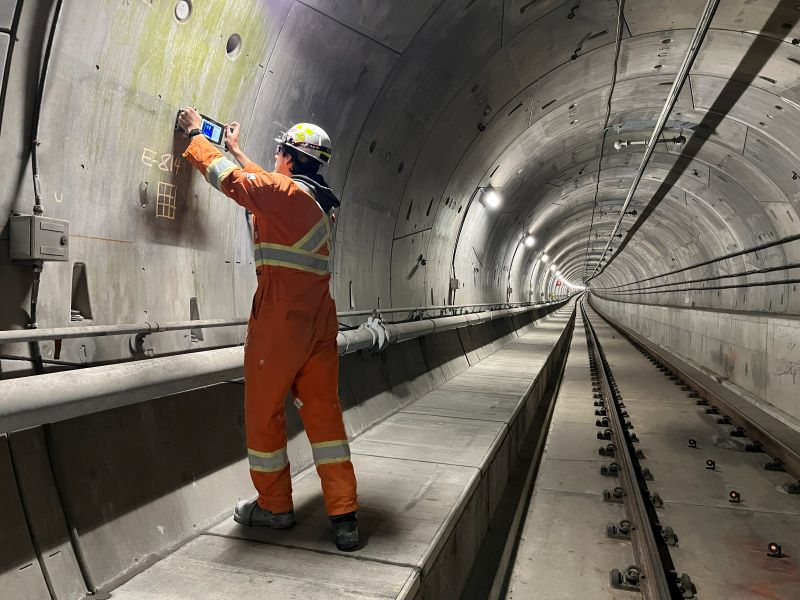
The most sophisticated layer of the multi-technology approach was the Non-Destructive Evaluation (NDE) program led by FPrimeC. Visual and spatial data can only describe the exterior boundaries of the concrete; NDE penetrates the material to evaluate its internal quality, uniformity, and integrity without causing any harm to the structure itself. To achieve a comprehensive subsurface profile, four distinct NDE modalities were deployed, each chosen for its unique diagnostic strengths.
- Rebound Hammer Testing was utilized as a rapid, effective method for assessing the surface hardness and overall uniformity of the concrete across vast stretches of the tunnel linings and station walls. By measuring the elastic rebound of a spring-loaded mass impacting the concrete, this technique provided immediate, widespread data on the consistency of the concrete matrix, helping to quickly isolate any localized zones of degradation or poor curing.
- Ultrasonic Pulse Velocity (UPV) added a deeper layer of material analysis. By transmitting ultrasonic waves through the concrete and measuring the time it takes for those waves to travel between transducers, the assessment team could evaluate the internal consistency and quality of the concrete mass. Faster wave velocities generally correlate with dense, high-quality concrete, while slower velocities indicate internal micro-cracking, porosity, or deterioration. This allowed for the verification of concrete integrity deep within the precast segments and cast-in-place headwalls, moving far beyond surface-level assumptions.
- Ultrasonic Pulse Echo (UPE) was specifically deployed to profile the thickness of the concrete elements and hunt for hidden internal anomalies. UPE relies on waves reflecting off internal interfaces—such as the back wall of a tunnel segment or internal air voids. This technology proved invaluable for confirming that the installed concrete matched the intended design thickness, while simultaneously scanning for critical hidden defects like internal delaminations, widespread voids, or poor consolidation that visual inspections could never detect.
- Ground Penetrating Radar (GPR) completed the NDE suite by utilizing high-frequency electromagnetic waves to image the subsurface architecture. GPR is unparalleled in its ability to map embedded steel reinforcement, allowing the team to verify the depth, spacing, and presence of rebar layers within the tunnel segments. Furthermore, GPR acts as a crucial tool for void detection, cross-verifying the structural thickness measurements obtained by the UPE scans and ensuring there were no significant anomalies behind the immediate concrete boundary.
The Synergy of Integrated Methodologies
The true power of this project’s methodology lies not in any single technology, but in the seamless integration of all three investigative streams. When a visual survey identifies a hairline crack or calcite leaching, NDE tools like UPV and UPE are deployed directly over that anomaly to determine if it is a superficial blemish or a symptom of deep internal fracturing. When LiDAR detects a zone of elevated radial ovality, GPR and Rebound Hammer data can confirm whether the concrete in that high-stress zone is maintaining its structural density or beginning to yield.
By overlapping high-resolution geometric profiling, rigorous physical condition mapping, and advanced multi-modal subsurface imaging, FPrimeC and its partners created an impenetrable baseline record of the transit infrastructure. This multi-technology framework removes the guesswork from condition assessments of tunnel, ensuring that any future structural changes, construction impacts, or maintenance requirements are measured against an incredibly precise, data-rich benchmark. It represents the pinnacle of modern structural evaluation, ensuring that the hidden lifelines of urban infrastructure remain robust, predictable, and fundamentally safe.