
How Structural Monitoring Helps Asset Managers ?
Data-Driven Insight for Safer Structures and Foundations
Protecting bridges, industrial assets, buildings, and foundation systems through advanced structural monitoring
As a maintenance manager or structural engineer, you know that continuous construction activity, heavy industrial operations, and environmental exposure constantly test the limits of your infrastructure. Without reliable monitoring, critical maintenance decisions are often based on visual assumptions rather than measured structural responses. This guesswork increases safety risks, invites unexpected downtime, and drives up long-term repair costs.
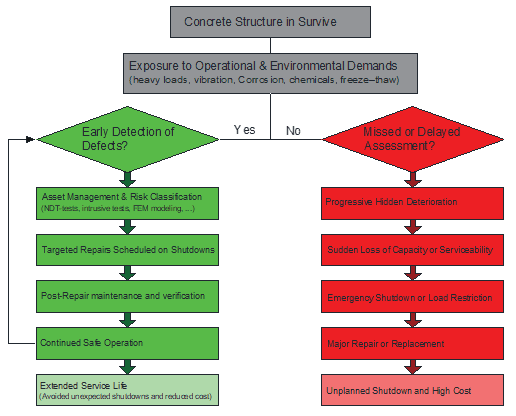
Timely detection is your best defense. Assessing a structure’s health allows you to identify subsurface damage before it escalates into a catastrophic failure. As illustrated below, structures are continuously exposed to heavy loads, vibration, and freeze-thaw effects that gradually compromise performance.
When defects are caught early, you can leverage condition assessment tools (like NDT and structural analysis) to classify risks and plan targeted repairs during scheduled shutdowns. In contrast, delayed assessments allow hidden deterioration to progress unnoticed, eventually forcing emergency shutdowns, sudden losses of load capacity, and massively inflated, unplanned costs.
Several guidelines are available for effective monitoring and structural health monitoring of concrete structures (i.e. ACI 444)
Our Approach: Tailored Instrumentation, Actionable Data
Every structure behaves differently under stress. At FPrimeC, we don’t just install sensors; we engineer structural health monitoring programs tailored to your asset’s specific risks, loading conditions, and lifecycle objectives. Our goal is to provide the reliable field data you need to make confident, informed engineering decisions.
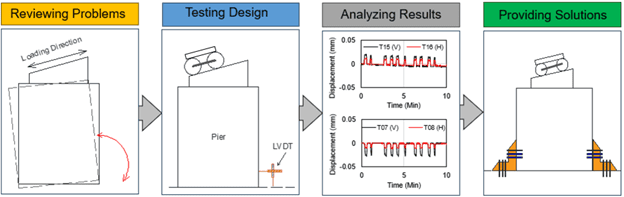
Consider the workflow for managing structural concerns in concrete piers under cyclic loading. We begin by reviewing the core problem—identifying likely loading directions, observed movements, and potential failure mechanisms. Based on that engineering assessment, we design a precise testing program. We analyze the resulting data to evaluate the magnitude and pattern of movements over time, allowing us to clearly distinguish between normal operational vibrations and dangerous signs of progressive fatigue.
Advanced Instrumentation for Complex Projects
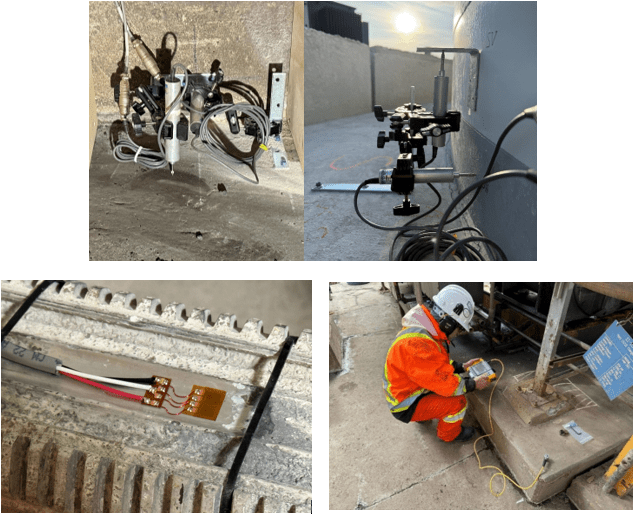
Depending on the parameters that need to be captured, we deploy advanced systems commonly used across Canadian high-rises, bridge networks, and industrial facilities:
| Instrumentation | What It Measures | Why It Matters for Your Asset |
| Load Cells | Applied forces in structural elements. | Ensures members are not exceeding their designed load capacity. |
| Strain Gauges | Localized stress and material response. | Identifies exactly where a material is experiencing the most fatigue. |
| LVDTs | Displacement and relative movement. | Tracks vertical and horizontal shifts to monitor overall stability. |
| Accelerometers | Vibration and dynamic behavior. | Evaluates how external forces (like heavy traffic or machinery) impact the structure. |
(Learn more about the specific sensors we use in Structural Monitoring here).
Applications of Structural Monitoring
From planning and sensor selection to installation oversight and data interpretation, our structural engineering team helps you understand actual structural behavior. Our monitoring solutions include:
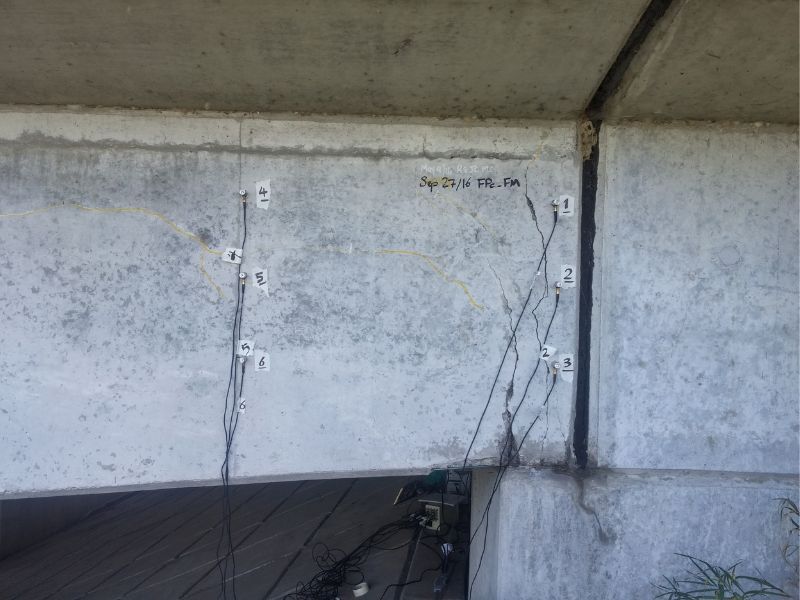
1- Crack Monitoring: Track the progression of existing or newly developed cracks over time to assess severity. This is essential to identify the nature of cracks (dormant or dynamic). Crack monitoring can be used to evaluate the structural response of critical elements, such as piers, beams, and girders.
2- Vibration Monitoring: Evaluate the effects of construction, demolition, traffic, and industrial operations on aging infrastructure. Vibration monitoring can also be used as part of new construction projects.
3- Settlement & Displacement Tracking: Monitor buildings, foundations, and adjacent retaining systems to prevent foundational failure.
4- Tilt & Deformation Monitoring: Ensure the verticality and structural integrity of walls, facades, towers, and bridge piers.
5- Strain & Load Instrumentation: Capture the true structural response under both operational and construction loading.
The Bottom Line: Why Measured Data Matters
We help facilities transition from hoping a structure is safe to knowing it is safe. Clients partner with us for structural monitoring to gain:
-
Early Warnings: Instant detection of abnormal structural responses or distress.
-
Targeted Repairs: Hard data to support highly specific retrofit and rehabilitation decisions, saving money on unnecessary fixes.
-
Risk Mitigation: Improved safety management during heavy excavation, foundation work, and nearby demolition.
-
Extended Asset Life: Long-term condition tracking that reduces maintenance uncertainty and maximizes ROI.
-
Defensible Documentation: Clear, objective reporting for owners, contractors, consultants, and insurance providers.