
What is Half-Cell Corrosion Potential Mapping for Concrete ?
Applications, Limitations, and Guidelines
Corrosion of embedded steel reinforcement is one of the leading causes of deterioration in concrete infrastructure. Once corrosion initiates, the expansive rust by-products cause the surrounding concrete to crack and spall, significantly reducing the structure’s service life.
To prevent catastrophic failures and optimize repair budgets, engineers rely on Half-Cell Potential (HCP) Mapping. Half-Cell corrosion mapping offers a rapid, cost-effective, and non-destructive way to evaluate the likelihood of active corrosion in reinforced concrete elements.
Half-Cell Potential Mapping
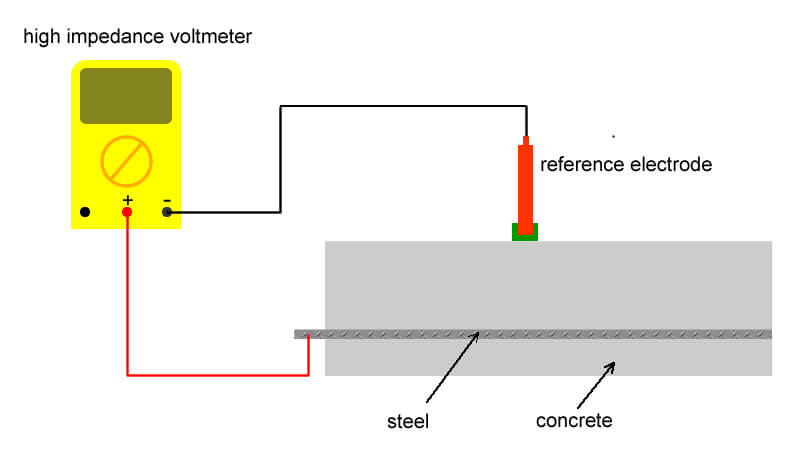
Half-Cell Potential mapping is an electrochemical test that measures the voltage (potential difference) between a standard reference electrode placed on the concrete surface and the embedded steel reinforcement below.
Typically, a copper/copper sulfate (Cu/CuSO4) or silver/silver chloride (Ag/AgCl) reference electrode is used. Because actively corroding steel changes the electrical potential of the surrounding environment, this test allows engineers to map out areas of high corrosion probability without having to break open the concrete.
Relevant Codes and Standards
When assessing structural integrity, it is critical to rely on standardized testing methodologies. The Half-Cell Potential test is guided by several prominent international standards:
-
ASTM C876: The “Standard Test Method for Corrosion Potentials of Uncoated Reinforcing Steel in Concrete” is the primary regulatory guideline for this test.
-
RILEM TC 154-EMC: The RILEM Technical Recommendations provide comprehensive guidelines on half-cell potential measurements and emphasize the relationship between concrete resistivity, chloride penetration, and corrosion risk.
- ACI Guidelines ACI 228.1R: The American Concrete Institute widely integrates HCP testing into its condition assessment protocols, utilizing the data to pinpoint areas requiring structural remediation.
Interpreting Half-Cell Test Results
The interpretation of HCP data is generally qualitative and dictates the probability of active corrosion. According to the guidelines set forth by ASTM C876 using a Copper/Copper Sulfate Electrode (CSE), the results are categorized as follows:
-
More positive than -200 mV: There is a less than 10% probability of active corrosion.
-
Between -200 mV and -350 mV: The probability of active corrosion is uncertain.
-
More negative than -350 mV: There is a greater than 90% probability of active corrosion.
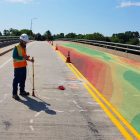
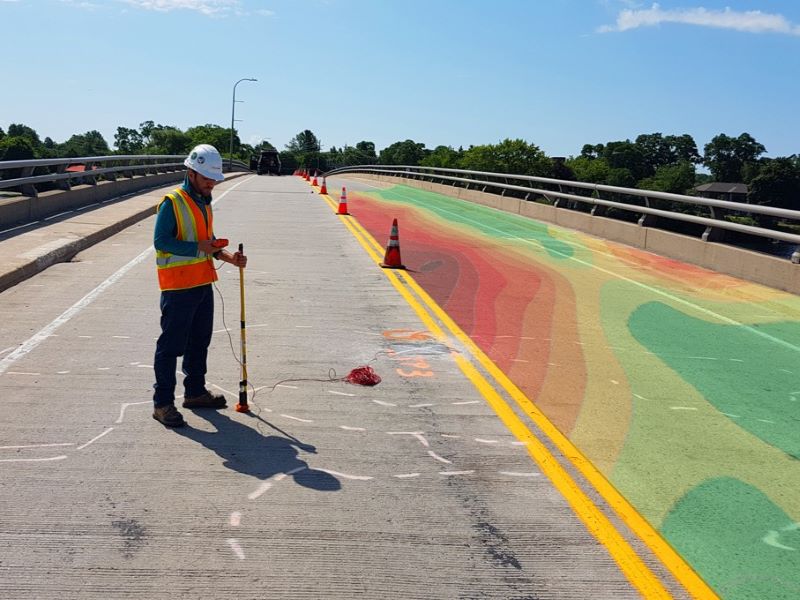
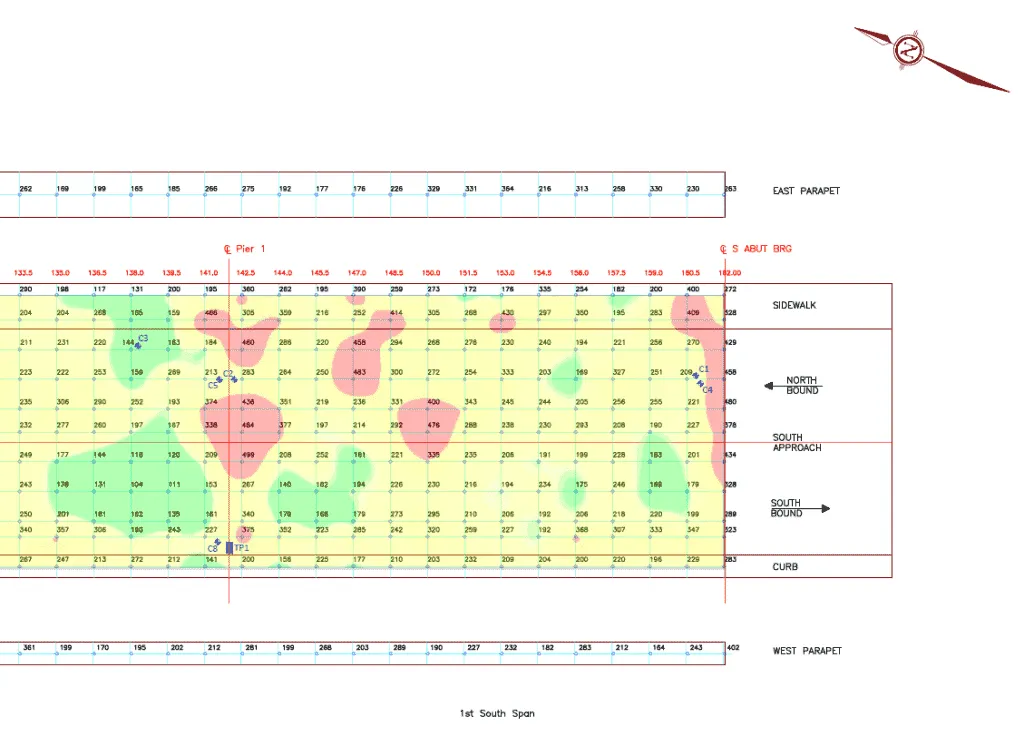
Test results are predominantly presented using equipotential contour maps, which visually display the gradient of potential values across the tested surface to highlight deterioration hotspots.
Step-by-Step Testing Procedure
While the test concept is simple, field execution requires precision. The general procedure involves:
-
Measurement Points & Grid Layout: A schematic grid is established over the test area. A finer mesh provides higher resolution but increases testing time and cost.
-
Rebar Connection: The concrete cover is locally removed (often by drilling) to establish a direct, sound electrical connection to the reinforcing steel.
-
Connectivity Test: The reinforcing steel must be electrically continuous across the testing zone, which can be verified using a multimeter.
-
Pre-wetting the Surface: If the concrete is dry, the surface must be pre-wetted using a sponge or spray to ensure adequate electrical conductivity. However, free-standing water must be avoided.
-
Perform Measurements: Using a high-impedance voltmeter, readings are taken at each grid node and recorded to the nearest 0.01 V once the value stabilizes.
Applications in Structural Engineering and Case Studies
Half-cell potential mapping is heavily utilized across a variety of infrastructure projects:
-
Bridge Decks and Tunnels: HCP is highly effective over large areas, making it ideal for mapping chloride-induced corrosion on aging bridge decks and marine structures. For example, in laboratory and field case studies of reinforced concrete decks subjected to heavy chloride salts, HCP mapping successfully pinpointed high-risk corrosion zones prior to visible structural cracking.
-
Targeting Destructive Testing: Instead of blindly coring into a structure, engineers use HCP maps to choose precise locations for destructive chloride analysis or concrete breakout.
-
Quality Assurance: The test is highly valuable for evaluating the effectiveness of previous concrete repairs and rehabilitation work.
Limitations and Influencing Factors
While powerful, the Half-Cell Potential test has distinct limitations that engineers must account for:
-
No Data on Corrosion Rate: The test only identifies the likelihood of active corrosion; it does not provide any information regarding the kinetics or rate at which the steel is deteriorating.
-
Moisture Sensitivity: Water-saturated concrete devoid of oxygen can shift potential readings to extremely negative values (e.g., -900 mV), creating false positives. Conversely, very dry concrete significantly increases electrical resistivity, skewing results.
-
Coatings: The presence of epoxy-coated rebar, asphalt overlays, or surface sealants prevents the necessary electrical circuit from forming, rendering the test ineffective.
-
Carbonation: Heavily carbonated concrete can shift potential readings toward more positive values, complicating ASTM C876 interpretations.